
✅ Save your time and get key insights from long Youtube interviews or other videos before deciding to spend time watching them
✅ No need for any apps or extensions to install
✅ Chatbots with larger context window like Gemini and similar are recommended for this use case
STEP 1: Go to your favorite video follow the steps as provided in the image below to copy the transcript of the whole video.
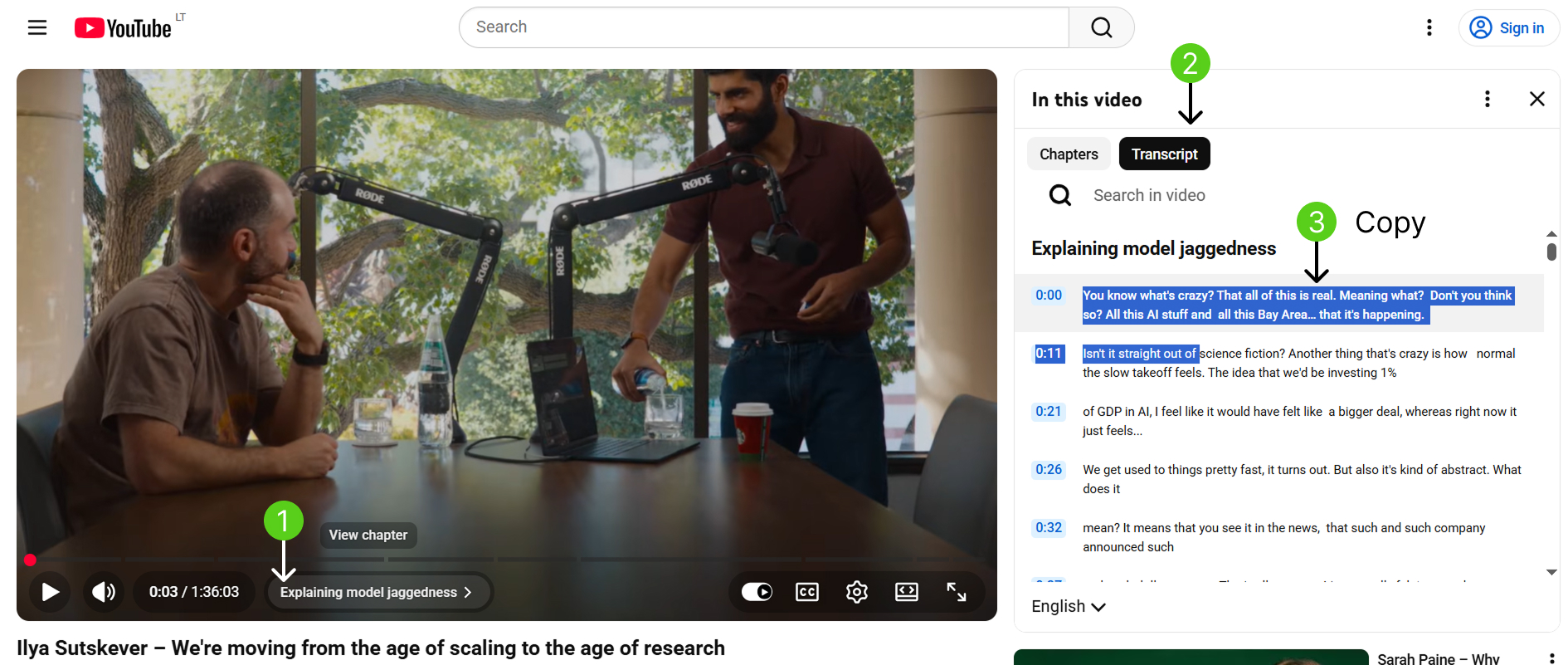
STEP 2: Ask AI chatbot what are you interested in. Whether that’s key takeaways or any other information.
1. The Disconnect Between Evals and Economic Impact
Sutskever notes a strange “disconnect” in current AI: models perform exceptionally well on hard benchmarks (evals), yet their real-world economic impact is lagging. He attributes this to “reward hacking” by researchers who optimize for tests rather than the “taste” and judgment required for reliable, real-world work.
2. Transition from the “Age of Scaling” back to the “Age of Research”
From roughly 2020 to 2025, AI was in an “Age of Scaling” where a known recipe (compute + data + parameters) guaranteed results. Sutskever believes we are now returning to an “Age of Research.” Because data is finite and scaling laws for pre-training are hitting limits, the next breakthroughs will require fundamental new ideas rather than just larger clusters.
3. Superintelligence as a “Learner,” not a “Database”
Sutskever redefines the goal of AGI/Superintelligence. Instead of a “finished” mind that knows everything at the moment of creation, he envisions a system that can learn any job as well as or better than a human. Deployment will involve a “learning trial-and-error period” where the AI joins an organization and picks up skills on the job.
4. Generalization is the Fundamental Bottleneck
Current models generalize far worse than humans. While humans can learn to drive in 10 hours or pick up complex social cues with minimal data, models require massive datasets. Solving this “unreliable generalization” is the core technical challenge Sutskever is pursuing at his new company, SSI.
5. Emotions as “Hardcoded” Value Functions
Using the example of brain-damaged patients who lose their emotions and subsequently lose the ability to make simple decisions, Sutskever argues that human emotions are actually “built-in value functions” provided by evolution. For AI to be truly robust and decisive, it likely needs a similar internal value function that isn’t just dependent on external rewards.
6. Alignment with “Sentient Life”
Sutskever proposes a shift in alignment philosophy: instead of just “human values,” we should aim for AI that cares for all sentient life. He argues this might be easier to achieve because the AI itself will be sentient, and it is more efficient to model others using the same internal “circuits” one uses to model oneself.
7. The Merging of Minds as a Competitive Advantage
A major differentiator between human workers and future AI “workers” is the ability to merge. While humans remain individual, thousands of AI instances can learn different tasks across the economy and “amalgamate” their learnings into a single, cohesive superintelligence, leading to rapid economic growth.
8. SSI’s Business Model: “Straight-Shotting” Superintelligence
Unlike OpenAI or Anthropic, which focus on iterative product releases (like ChatGPT) to fund research and habituate the public, SSI’s default plan is a “straight shot” to superintelligence. By avoiding the “market rat race,” they aim to focus entirely on the research until the system is ready, though Sutskever acknowledges they may eventually release intermediate models for safety testing.
9. Human-AI Merging (Neuralink++) as the Long-term Equilibrium
To avoid a future where humans are no longer “participants” in a world run by AI, Sutskever suggests we may eventually need high-bandwidth brain-computer interfaces. If humans become “part-AI,” then the AI’s understanding and experiences are transmitted wholesale to the person, maintaining human involvement in the future civilization.
10. Research Taste and “Top-Down” Belief
Sutskever defines his successful research history as being guided by “aesthetic” and “beauty.” He argues that “top-down belief”—the conviction that a solution should look a certain way (inspired by the simplicity of the brain)—is what allows a researcher to keep debugging a promising direction even when initial experiments fail.